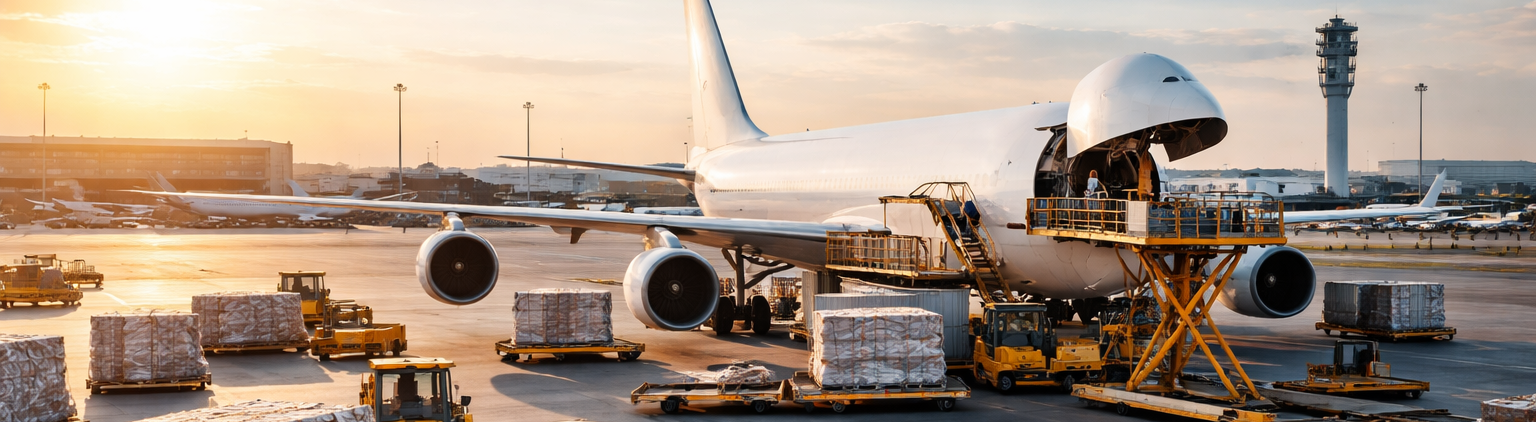

Air freight transport is undergoing a reconfiguration phase driven by changes in global trade, the reorganisation of supply chains and the increasing demand for speed in distribution.
Air logistics consolidates its role as critical infrastructure for industries operating with high-value products, sensitive times and complex international networks.
Recent data from the International Air Transport Association (IATA) show a sustained recovery of the volume of air cargo following the pandemic-generated disruption, with tariff stabilization and progressive standardization of available capacity. This context is associated with structural changes that have a direct impact on the strategy of airlines, logistics operators and exporting companies.
Capacity and reconfiguration of routes
The availability of air capacity is evolving depending on the return of passenger traffic and the expansion of dedicated cargo fleets. During the pandemic, the use of passenger aircraft for cargo allowed the global operation to be sustained. At present, the reposition of commercial traffic redefines the balance between commercial aircraft wineries and pure freighters.
The routes also show relevant changes. The growth of trade between Asia and Latin America, together with the strengthening of intra-regional corridors, drives new direct connections. Strategic airports in Brazil, Mexico, Colombia and Chile increase their role as logistics hubs.
Neartering to Latin America, particularly in industrial and technological sectors, increases the need for efficient air solutions to connect productive chains to consumer markets in the United States and Europe.
E-commerce and speed demand
The sustained growth of e-commerce raises the demand for delivery times. Global retail and marketing companies integrate air transport solutions into their logistics models to ensure fast delivery in key markets.
This phenomenon promotes investments in distribution centres near airports, process automation and real-time inventory management systems. The air logistics is integrated with land and sea networks in multimodal schemes that optimize costs and times.
In Latin America, the development of cross-border e-commerce generates a growing demand for air cargo services, especially for electronic products, clothing and high-value consumer goods.
Digitization and operational efficiency
The incorporation of technology into the air logistics advances with a focus on traceability, route optimization and documentary automation. Digital platforms allow to monitor real-time shipments, reduce operational errors and improve coordination between chain actors.
The adoption of standards such as e-AWB (electronic air waybill) accelerates administrative processes and reduces costs. According to IATA, the complete digitization of documentation represents one of the main efficiency opportunities for the sector.
Artificial intelligence is being used for demand projection, capacity allocation and operational risk management. These tools improve fleet use and reduce inactivity times.
Sustainability and regulatory pressure
The environmental impact of air transport creates pressure on the sector to advance sustainable solutions. Airlines and logistics operators invest in sustainable aviation fuels (SAF), fleet renewal and emission-reduction optimization.
Europe leads the implementation of more demanding environmental regulations, which impacts global operations. Companies operating in international markets must adapt to these standards in order to maintain their competitiveness.
In Latin America, the adoption of sustainable practices is progressing progressively, driven by international customer demands and access to financing linked to ESG criteria.
Strategic perspective: integration, scale and regional positioning
Air logistics is evolving towards integrated models where coordination between transport, storage and distribution defines system efficiency. Operators who manage to scale up operations and consolidate regional networks strengthen their competitive position.
For exporting companies, access to reliable and rapid logistics solutions directly affects their ability to compete in global markets. Logistics planning is incorporated as a strategic variable in commercial decision-making.
Opportunities in Latin America are concentrated on:
- Development of regional logistics hubs.
- Investment in airport infrastructure.
- Integration of digital solutions.
- Expansion of services linked to e-commerce.
Operating cost volatility, reliance on macroeconomic conditions and regulatory developments are a scenario that requires adaptation capacity and long-term vision.
