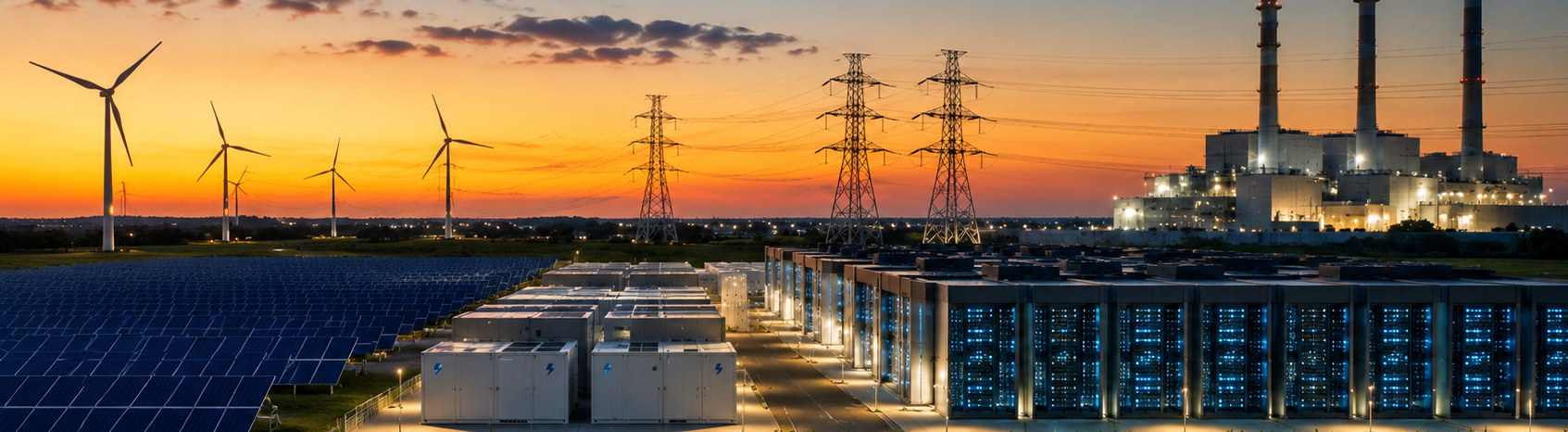
IA and energy

Artificial intelligence drives a new global career for energy

The growth of artificial intelligence is generating a profound transformation in energy markets.

The expansion of data centres, digital infrastructure and intensive processing systems is increasing global electricity demand and accelerating investment in generation, networks and storage.

Data centres become large new energy users

Generative artificial intelligence entered an accelerated adoption stage. Technology companies, governments and multi-industry organizations are incorporating IA models to automate processes, develop products and increase productivity.

Behind that transformation is a variable that begins to gain prominence in the global energy agenda: electricity consumption.

Advanced models of artificial intelligence require enormous processing capabilities. Each new generation of data centres requires more computer power, more cooling and permanent availability of energy.

According to projections of the International Energy Agency (IEA), data centres will be one of the main drivers of growth in electricity demand over the next decade.

Energy is consolidated as a strategic factor to sustain digital expansion.

Energy infrastructure enters a new stage of investment

The global energy discussion incorporates a new priority: to ensure sufficient capacity to supply the growing demand associated with the digital economy.

Lead technology companies are signing long-term energy supply agreements to ensure operational stability and cost predictability.

At the same time, electricity companies, network operators and investment funds are accelerating projects related to:

  • Renewable generation.
  • Energy storage.
  • Extension of transmission networks.
  • Modernization of distribution systems.
  • Support infrastructure for data centres.

Energy availability is beginning to influence decisions to locate new technological investments.

Regions with access to competitive energy, network capacity and regulatory stability acquire a growing advantage in attracting projects linked to artificial intelligence.

The electrical network emerges as a strategic asset

The growth of electricity demand is shifting part of the focus from generation to networks.

In many developed markets, the times needed to connect new energy or technological projects create challenges for capacity expansion.

Investment in transmission and distribution becomes relevant within national energy plans.

This phenomenon is promoting opportunities to:

  • Electrical equipment manufacturers.
  • Infrastructure developers.
  • Network operators.
  • Companies specialized in energy digitization.
  • Suppliers of storage solutions.

The quality and availability of electricity infrastructure become factors that have a direct impact on economic competitiveness.

Energy and technology consolidate a new strategic relationship

Historically, the energy and technological sectors evolved with relatively independent dynamics.

The expansion of artificial intelligence is generating an ever-deeper convergence between the two ecosystems.

Large technologies are actively involved in energy projects, finance renewable developments and explore direct agreements with generators to ensure long-term supply.

Energy begins to be part of the corporate strategy of companies whose main business is linked to software, data and digital innovation.

This integration is changing the competitive dynamics of both sectors.

Latin America finds an opportunity for positioning

The region has relevant attributes to participate in this new phase of the global energy market.

The abundance of renewable resources, the availability of facilities for infrastructure expansion and the growth of investment in generation offer favourable conditions for attracting projects linked to digital economy and artificial intelligence.

Countries with stable regulatory frameworks, access to long-term financing and energy planning can capture a significant part of the investments that will seek new locations for data centres and technology operations.

The capacity to articulate energy policies, infrastructure and productive development will have a direct impact on regional competitiveness over the coming years.

Energy takes on a central role in the economy of artificial intelligence

The expansion of artificial intelligence is incorporating a new variable into the global business agenda: energy availability.

The capacity to generate, transport and manage electricity will be crucial to sustain the growth of digital infrastructure.

Energy companies, technological developers, investors and governments are entering a stage where energy, data and computer capacity are part of the same strategic equation.

The evolution of this trend will have a direct impact on investment, competitiveness and economic development in multiple industries.

Slide

Evaluate a commercial diagnosis

Identify blocks and real opportunities for growth.


Solar panels: what variables today define the profitability of the energy business

Solar energy consolidates its position as a structural axis of the global energy transition.

The sustained fall in technological costs, along with regulatory pressure and corporate demand for clean energy, drives its adoption in multiple productive sectors.

Market growth has a more complex dynamic. The competitiveness of the solar business depends on financial, regulatory and commercial variables that have a direct impact on project profitability.

Falling from technological costs and market expansion

The reduction in the cost of solar panels over the last decade is one of the main drivers of the sector's growth. Reports from international agencies such as the International Energy Agency (IEA) and BloombergNEF show a sustained downward trend in the cost per watt installed.

This phenomenon extends access to solar solutions in industrial, commercial and residential segments. The increase in the global scale, led by China, consolidates an abundant and competitive offer.

Economic impact:
The reduction of CAPEX improves project viability and shortens investment recovery periods.

Strategic implications:
Companies face a market with lower entry barriers and greater price competition.

Regulatory volatility and pressure on business models

The regulatory environment plays a decisive role in the profitability of the sector. Changes in subsidy schemes, network injection rates and tax frameworks directly affect the income flow of solar projects.

In Latin America, regulatory heterogeneity generates different scenarios between countries. Markets such as Brazil and Chile advance in more stable frameworks, while others present policy uncertainty.

Economic impact:
The predictability of income flow becomes a critical variable for the financial structure of projects.

Common error:
To underestimate the regulatory risk in the investment assessment.

Strategic implications:
Companies prioritize markets with regulatory stability and design stronger contractual structures.

The role of financing in solar expansion

Access to finance defines the scale of growth in the sector. The participation of multilateral banks, investment funds and green financing mechanisms promotes the development of large-scale projects.

The cost of capital becomes a central variable. High interest rates impact profitability, especially in emerging economies.

Economic impact:
Financing conditions the viability of projects and defines the speed of expansion of the sector.

Strategic implications:
Companies seek more efficient financial structures and partnerships with institutional actors.

Storage integration and intermittent management

The incorporation of energy storage systems strengthens the solar energy value proposal. The batteries allow to manage intermittent and improve supply stability.

Technology development in storage is progressing rapidly, with cost reduction and efficiency improvements.

Economic impact:
The combination of solar generation with storage increases the value of the energy produced.

Strategic implications:
Hybrid projects gain relevance in energy-intensive industrial sectors.

Corporate self-consumption as a growth engine

Industrial and commercial companies adopt distributed generation solutions to optimize costs and reduce exposure to price variations.

Self-consumption is consolidated as an active energy strategy, aligned with sustainability and operational efficiency objectives.

Economic impact:
Reducing energy cost improves operational margins in consumer-intensive sectors.

Strategic implications:
Energy is integrated as a key variable in business competitiveness.

Increasing competition and the need for differentiation

The growth of the sector attracts new players, from developers to technological integrators. Competition intensifies and pressures margins.

The differentiation is built on technical capabilities, financing, operational efficiency and proposal of integral value.

Economic impact:
Competitive pressure reduces margins in standardized projects.

Common error:
To compete exclusively in price without developing strategic capacities.

Strategic implications:
Companies must define clear positioning and develop sustainable competitive advantages.

Strategic perspective for the sector

The solar panel market has a sustained growth trajectory with increasing complexity. Profitability depends on the ability to manage critical variables such as regulation, financing, technology and business model.

Companies operating in this sector are facing a scenario that requires strategic decisions in the medium and long term. Vertical integration, development of hybrid solutions and expansion to new demand segments appear as relevant lines of action.

Solar energy is placed as a structural component in the global energy matrix and in the operational strategy of companies.

Slide

Evaluate a commercial diagnosis

Identify blocks and real opportunities for growth.