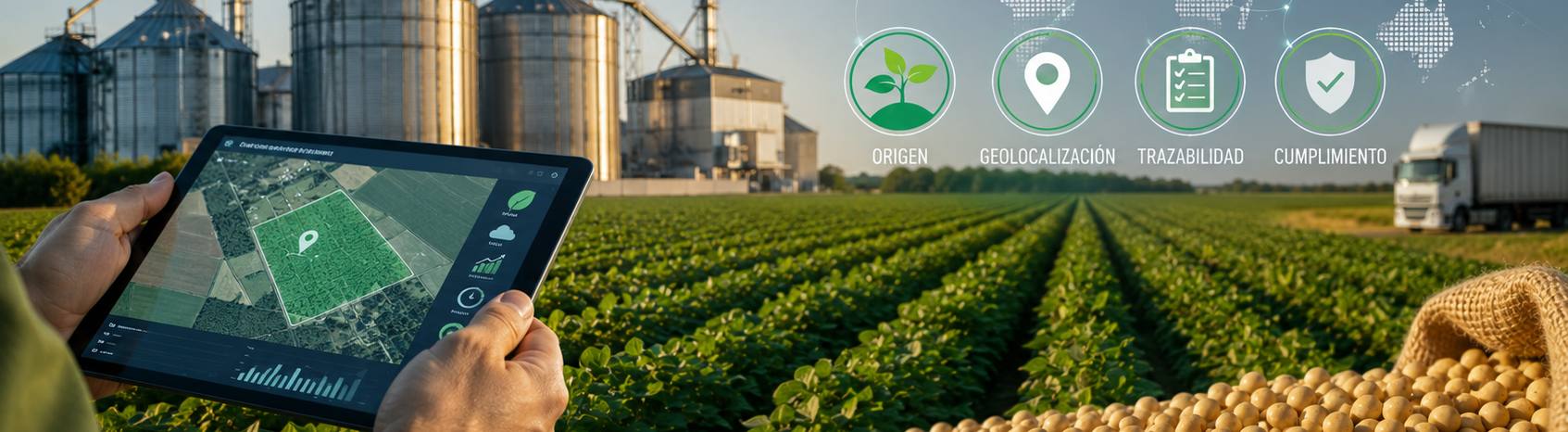

Global agro-industry is undergoing a structural transformation driven by new regulatory requirements, environmental pressure and changes in international purchasing criteria.
Tracability ceased to be an operational differential and became a condition of access for multiple strategic markets.
Europe leads much of that process. The implementation of the European Regulation against Deforestation (EUDR) incorporates source validation requirements for agro-industrial products linked to environmentally sensitive chains. Soak, beef, coffee, cocoa, wood and derivatives are part of the regulatory scope.
The change has a direct impact on Latin America.
The region concentrates a significant share of global exports of agricultural food and commodities. Brazil, Argentina, Paraguay, Uruguay, Colombia and other exporting markets are beginning to face increasing pressure on certification, documentary control and digital traceability.
Agro-export competitiveness is beginning to depend on variables that historically played a secondary role in the commercial structure.
Tracability advances to the centre of the export strategy
For years, much of regional agro-industrial competitiveness was associated with productivity, scale and logistics efficiency.
The new scenario adds another critical variable: the ability to demonstrate origin, productive practices and complete chain travel.
International buyers are incorporating stricter requirements on:
- Production geolocation.
- Environmental monitoring.
- Documentary validation.
- Policy compliance.
- Identification of suppliers.
- Operational transparency.
The impact reaches both direct exporters and industries linked to international processing, distribution and marketing.
Tracability begins to function as a mechanism of commercial validation and risk reduction for global buyers.
Europe accelerates global regulatory change
The European Regulation against Deforestation became one of the main processing catalysts for the exporting agribusiness.
The rules require that certain products do not come from deforested areas after December 2020 and set due diligence obligations for operators and traders.
The effect transcends Europe.
International regulations often expand standards over the entire global supply chain. Exporting companies are beginning to adapt processes even in markets where regulatory requirements are not yet mandatory.
The phenomenon also influences:
- International funding.
- Commercial insurance.
- Access to premium chains.
- Supply agreements.
- Relations with big retailers.
Tracability gains weight as a reputational and financial variable.
Productive fragmentation increases operational complexity
Latin America has a heterogeneous and highly fragmented agro-industrial structure in multiple chains.
This scenario creates relevant challenges for implementing integrated traceability systems.
The difficulties are at different levels:
- Geographical displacement.
- Low digitization.
- Manual documentation.
- Multiples of intermediaries.
- Technological differences between producers.
- No data integration.
Dependence on traditional trade structures also limits speed of adaptation.
In several regional markets, an important part of agro-industrial operations continues to operate with low capacity for comprehensive digital monitoring.
Regulatory pressure accelerates the need for technological investment and operational reorganization.
Technology begins to define market access capacity
Digital tools linked to traceability are rapidly advancing within the agro-industrial ecosystem.
Exporting companies and global operators incorporate:
- Blockchain.
- Satellite monitoring.
- Certification platforms.
- Artificial intelligence applied to documentary validation.
- IoT sensors.
- Integration of productive data.
- Specialized ERP systems.
The objective is focused on continuous audit, control and validation capacity.
Technology ceases to function only as an efficiency tool and becomes integrated into the export competitiveness structure.
Companies with the highest level of digital integration find advantages in:
- Regulatory response speed.
- Commercial access.
- Operational predictability.
- Reputational risk reduction.
- International negotiating capacity.
Intermediators lose value capture capacity
Mandatory traceability also changes the intermediation logic within agro-industry.
International buyers prioritize relationships with actors that can guarantee reliable information, validated documentation and visibility on productive origin.
This change strengthens companies with more chain integration and more professional business structures.
Organizations that rely exclusively on intermediaries face greater vulnerability to new regulatory and commercial requirements.
Access to premium markets is beginning to be concentrated in companies with comprehensive supply and compliance control capabilities.
The quality of information becomes part of the export added value.
The cost of adaptation impacts on margins
The implementation of traceability systems involves relevant investments in:
- Technology.
- Certifications.
- Training.
- Documentary digitization.
- Monitoring.
- Audits.
- System integration.
This process creates pressure on operational costs, especially for medium-sized producers and smaller-scale companies.
Agro-industrial profitability is beginning to depend on the ability to absorb regulatory costs without deteriorating commercial competitiveness.
The strategic challenge appears in how to transform compliance into competitive advantage.
Companies with more orderly structures, technological integration and long-term vision achieve greater capacity to adapt to the new scenario.
Latin America faces a strategic positioning opportunity
The region maintains relevant structural advantages in agro-industrial production.
Availability of natural resources, export capacity and productive scale continue to position Latin America as a central actor in global food supply.
The regulatory scenario opens a new stage where competitiveness will also be associated with transparency, validation and technological capacity.
Companies that manage to integrate traceability, trade structure and international positioning can strengthen access to higher value-added markets.
The global regulatory transformation accelerates the professionalization of the exporting agro-industry.
The trade structure gains strategic relevance
Mandatory traceability also changes the trade dynamics of the sector.
Commercial areas start to need:
- Integration with operation.
- Documentary validation.
- Analytical capacity.
- Market segmentation.
- Certification management.
- International regulatory reading.
Export competitiveness is increasingly dependent on coordination between production, technology and trade strategy.
Agroindustry enters a stage where the ability to demonstrate value will have a direct impact on export revenue, positioning and predictability.
