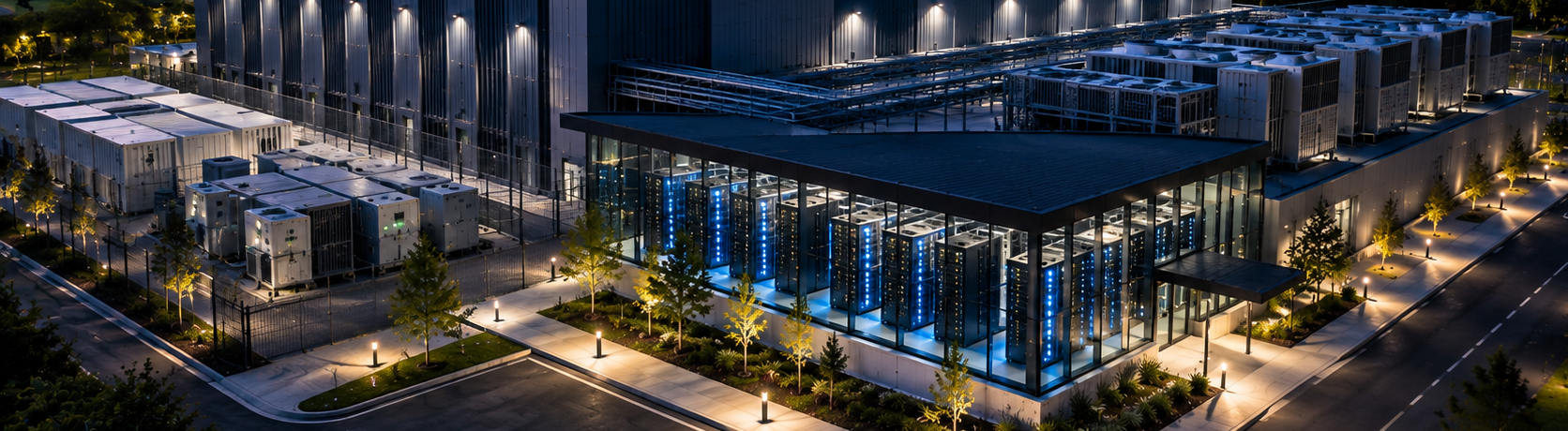

The expansion of artificial intelligence, the growth of data processing and the demand for digital infrastructure drive a new stage for the real estate market.
Data centers concentrate capital, change location criteria and generate opportunities for developers, investors and emerging markets.
Digital infrastructure is at the heart of the investment agenda
The real estate market is undergoing a transformation driven by the digital economy. The expansion of generative artificial intelligence, the growth of cloud computing and the multiplication of data-based applications increase the need for global technological infrastructure.
In this context, data centers are consolidated as one of the most demanded assets by institutional investors, infrastructure funds and specialized developers. Several international reports from PwC, Urban Land Institute and large investment firms place these assets among the main opportunities in the real estate sector for the coming years.
The demand comes from technology companies, cloud operators, streaming platforms, telecommunications companies and organizations that require increasing processing and storage capabilities.
The growth of digital traffic makes data centers an essential component for the functioning of the contemporary economy.
Energy availability becomes a strategic variable
The location of a real estate asset remains relevant, although the selection criteria evolve rapidly.
The ability to access reliable, scalable and competitive energy is of crucial importance for the development of new projects.
Large operators seek regions that can ensure stable power supply, high-capacity connectivity and favourable regulatory conditions for long-term investments.
This scenario drives a new logic of soil recovery. Land that historically had limited appeal for traditional developments begins to attract interest when they offer adequate energy infrastructure.
Urban and energy planning is beginning to have a direct impact on the real estate competitiveness of cities and regions.
Capital flows migrate to assets linked to the digital economy
Global real estate markets go through a more rigorous selection stage by investors.
The high interest rates in recent years have led to a thorough review of the criteria for capital allocation. The funds seek assets with structural demand, long-term contracts and prospects for sustained growth.
Data centers have much of these characteristics.
The expansion of artificial intelligence expands the need for computer capacity, as companies accelerate the digitization of processes, services and operations.
This dynamic generates a constant flow of demand that strengthens the financial attractiveness of these developments to other traditional market segments.
The consequence is visible: an increasing share of global real estate capital is directed towards technological infrastructure.
Latin America begins to win the role of the regional map
The region has conditions that begin to attract the attention of international operators.
Brazil, Mexico, Chile and Colombia concentrate much of the projects announced in recent years. The combination of digital growth, expansion of the consumption of technological services and the need for regional infrastructure drives new investments.
The Latin American market still has levels of development below those observed in the United States, Europe and Asia, which expands the long-term growth potential.
Cities that manage to strengthen their energy infrastructure, improve connectivity and provide predictable regulatory frameworks can capture a significant part of this expansion process.
For real estate developers, funds and infrastructure-related actors, the evolution of this segment represents a relevant opportunity to diversify portfolios and access markets with strong growth potential.
New challenges for developers and real estate investors
The development of data centers requires different capacities than conventional real estate assets.
The risk assessment incorporates energy, technological, regulatory and operational variables. Investment processes require a deeper understanding of digital infrastructure and the technological trends that drive demand.
The relationship between real estate, energy and technology is becoming increasingly integrated.
This convergence expands the need for strategic planning to identify competitive locations, understand demand developments and prioritize long-term vision investment opportunities.
Decisions made over the next few years will have a direct impact on the ability to capture value in one of the most growing segments within the global real estate market.
The technological infrastructure drives a new stage for the real estate
Data centers represent one of the most visible expressions of the convergence between digital economy and real estate investment.
The expansion of artificial intelligence, exponential data growth and the need for critical infrastructure strengthen the attractiveness of these assets for institutional investors and specialized developers.
The evolution of the sector opens up new opportunities for markets that can provide energy, connectivity and stability for large-scale projects.
