The visibility of the supply chain has an influence on logistical competition

The visibility In real-time supply chain is of strategic relevance in a market where information impacts on the profitability, confidence and continuity of contracts.

Logistics is undergoing a transformation driven by a growing demand for information. Industrial companies, retailers, e-commerce companies and organizations with complex operations incorporate new criteria for assessing their logistics suppliers. Among them, the ability to provide full visibility on the status of shipments, inventories and operational processes is increasingly relevant.

For years, operational efficiency concentrated much of the sector's attention. Traditional indicators linked to costs, delivery times and operational capacity remain critical. However, competitive dynamics incorporate a new variable: the quality of information available to the customer.

The visibility of the supply chain thus becomes a commercial asset with direct impact on loyalty and growth.

Information acquires economic value within the logistics proposal

Supply chains operate in environments characterized by greater volatility, stricter compliance requirements and increasing operational complexity.

In front of this scenario, customers seek to reduce uncertainty. The ability to know in real time the location of a load, anticipate deviations, monitor inventories or access to operational reports strengthens planning capacity and improves decision-making.

The information ceases to function only as an operational support and becomes part of the commercial value proposal.

Studies by international consultants such as McKinsey, Gartner and Deloitte show that organizations with higher visibility about their logistics operations are able to improve service indicators, optimize inventories and reduce costs associated with supply chain interruptions.

The business consequence is clear: customers assign economic value to the ability to access accurate and timely information.

Competitive pressure drives new service standards

The growth of e-commerce, the digitization of business processes and the expansion of monitoring platforms generate increasing expectations.

Corporate customers compare the logistical experience with the levels of visibility they find in other digital sectors. The permanent availability of information is gradually incorporated as a basic market expectation.

This changes the criteria for the evaluation of suppliers.

Timeliness remains important. The ability to report, anticipate and communicate acquires an equivalent relevance within the selection and stay processes of customers.

Logistic companies that offer monitoring platforms, custom dashboards, automatic alerts and integral traceability strengthen their positioning against competitors who compete mainly for price.

Tracability strengthens strategic accountability

Competition for tariffs creates constant pressure on the margins of the sector.

In this context, the construction of sustainable trade relations is increasingly dependent on the ability to generate perceived value.

Tracability contributes directly to this objective.

When a client can monitor critical operations, access historical information and have reliable indicators to manage his business, the business relationship becomes more strategic.

The conversation stops focusing exclusively on operational costs and begins to incorporate variables linked to planning, control and response capacity.

This change strengthens the permanence of strategic accounts and expands the possibilities of commercial expansion within existing customers.

Technological integration accelerates a new stage of differentiation

The expansion of Internet-related technologies of Things (IoT), intelligent sensors, artificial intelligence and data analysis platforms facilitates the construction of more transparent logistics models.

Technological investment is increasingly justified by commercial growth and customer retention.

Continuous data capture allows for the detection of incidents, the creation of early warnings and the construction of operational indicators with a level of detail higher than was available a few years ago.

Organizations that manage to integrate these capacities strengthen their capacity to respond to disruptive events and improve the experience of their clients.

The differentiation then arises from the ability to transform operational data into information relevant to decision-making.

The strategic challenge is to turn data into a competitive advantage

The availability of technology alone does not guarantee results.

Many organizations incorporate digital tools without a clear strategy to transform information into commercial value.

The competitive advantage appears when data can improve predictability, strengthen customer relationships and facilitate business decisions.

The challenge for logistics leaders is to identify which information generates value for each client segment and how to integrate it into a consistent service proposal.

Visibility becomes strategic when it helps to improve income, strengthen profitability and consolidate long-term relationships.

Visibility is incorporated into the core of logistics competitiveness

The evolution of supply chains shows a clear trend: operational transparency gains prominence in the factors that determine the competitiveness of the sector.

Logistic companies that develop traceability, monitoring and intelligent information management capabilities strengthen their position against increasingly demanding customers.

The next stage of growth of the sector will be associated with the ability to combine operational efficiency, data intelligence and customer experience within an integrated value proposal.


Slide

Evaluate a commercial diagnosis

Identify blocks and real opportunities for growth.


Bioenergies and biomaterials

Carbon footprint and environmental requirements: the new strategic agenda that drives opportunities in bioenergies and biomaterials

Sustainability is at the heart of the global agro-industry agenda.

The main markets incorporate environmental standards that change trade access conditions, strengthen the traceability of production chains and expand demand for carbon information. This scenario incorporates new operational challenges and opens up investment opportunities linked to the bioeconomy.

Agro-industrial companies face a context where the ability to measure, document and communicate their environmental performance becomes strategically relevant. Carbon footprint management is gradually integrated into commercial, financial and productive decisions.

Environmental traceability strengthens export competitiveness

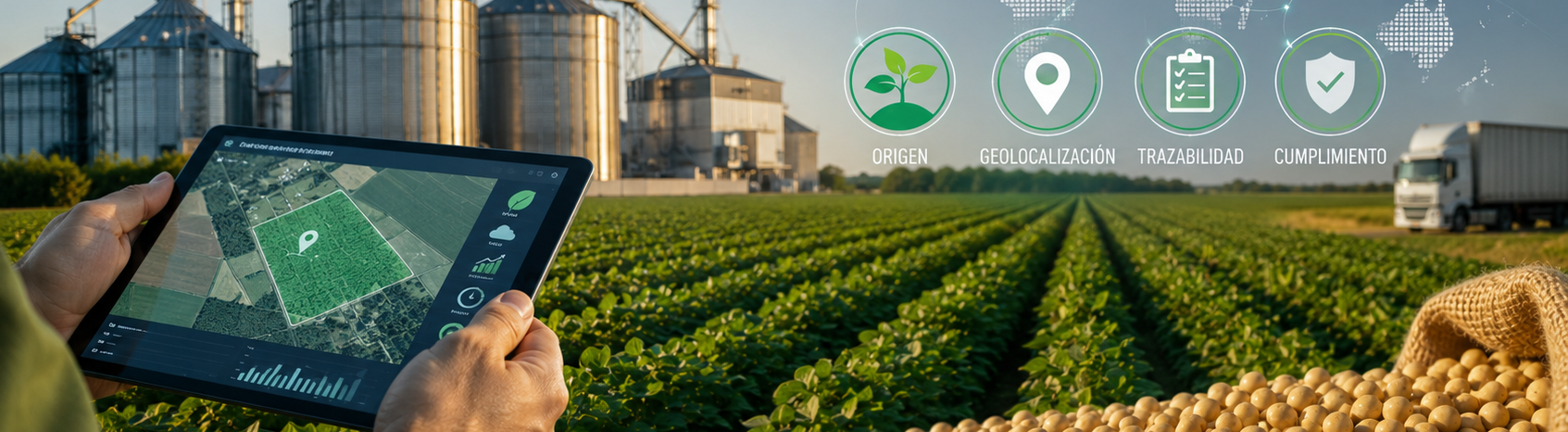
The European Union is making progress in implementing the Regulation on Deforestation Free Products (EUDR), a regulation that requires proof of the origin of certain raw materials and evidence that their production maintains specific environmental criteria. Soak, beef, wood, coffee, cocoa, palm oil and rubber are part of the initial scope of the regulation.

This process accelerates investments in georereference systems, digital traceability platforms, certifications and satellite monitoring. The quality of environmental information is beginning to be consolidated as a business asset with a direct impact on export continuity.

At the same time, other markets and large multinational companies incorporate their own sustainable supply policies, extending the scope of these requirements beyond official regulations.

The carbon footprint incorporates economic value into productive management

Emissions measurement is no longer an environmental indicator. Its use allows to identify energy efficiency opportunities, optimize processes, reduce operational costs and strengthen positioning against international customers.

Financial institutions also incorporate environmental criteria within their risk assessments, while many investment programmes prioritize projects with verifiable sustainability indicators.

This change promotes greater integration between production, technology and data management. Sensors, digital platforms, satellite images and artificial intelligence expand the ability to build reliable and auditable environmental indicators.

Agro-industrial waste drives new sources of income

One of the most relevant changes arises around the full use of biomass.

Agricultural waste, livestock effluent, forest by-products and industrial discards generate opportunities to develop bioenergy projects with the capacity to supply industrial processes, produce electricity, generate biogas or develop advanced biofuels. Argentina has specific programmes aimed at promoting the development of bioenergies and the use of agricultural biomass.

This development increases the potential profitability of historically underutilized assets and strengthens income diversification within agro-industrial enterprises.

Distributed generation, energy self-consumption and waste recovery consolidate a more efficient production model in resource use.

Biomaterials expand regional bioeconomy

The transition to materials of biological origin represents another of the great opportunities for agro-industry.

Bioplastics, plant fibres, biomaterials for construction, biodegradable packaging and biological-based chemicals expand the universe of applications derived from agricultural and forestry crops.

A number of countries increase investments to replace fossil inputs with renewable raw materials. This trend strengthens the development of higher value-added chains and promotes the articulation between agro-industrial companies, universities, technological centres and industrial manufacturers.

The availability of biomass places Latin America as a region with competitive advantages to supply this productive transformation.

The business strategy incorporates new decision variables

Sustainability is evolving towards a dimension linked to competitiveness, market access, financing and innovation.

Companies that develop capacities to measure emissions, strengthen traceability and value waste build relevant advantages against an international environment with higher environmental requirements.

Strategic planning incorporates decisions on certifications, technological investments, partnerships with specialized suppliers, integration of environmental data and development of new business models associated with the bioeconomy.

The convergence between agricultural production, renewable energy, circular economy and biomaterials extends the growth horizon for companies capable of integrating these capacities into their long-term strategy.

Slide

Evaluate a commercial diagnosis

Identify blocks and real opportunities for growth.


Tracability in agribusiness

Mandatory traceability and its impact on agro-export competitiveness

Global agro-industry is undergoing a structural transformation driven by new regulatory requirements, environmental pressure and changes in international purchasing criteria.

Tracability ceased to be an operational differential and became a condition of access for multiple strategic markets.

Europe leads much of that process. The implementation of the European Regulation against Deforestation (EUDR) incorporates source validation requirements for agro-industrial products linked to environmentally sensitive chains. Soak, beef, coffee, cocoa, wood and derivatives are part of the regulatory scope.

The change has a direct impact on Latin America.

The region concentrates a significant share of global exports of agricultural food and commodities. Brazil, Argentina, Paraguay, Uruguay, Colombia and other exporting markets are beginning to face increasing pressure on certification, documentary control and digital traceability.

Agro-export competitiveness is beginning to depend on variables that historically played a secondary role in the commercial structure.

Tracability advances to the centre of the export strategy

For years, much of regional agro-industrial competitiveness was associated with productivity, scale and logistics efficiency.

The new scenario adds another critical variable: the ability to demonstrate origin, productive practices and complete chain travel.

International buyers are incorporating stricter requirements on:

  • Production geolocation.
  • Environmental monitoring.
  • Documentary validation.
  • Policy compliance.
  • Identification of suppliers.
  • Operational transparency.

The impact reaches both direct exporters and industries linked to international processing, distribution and marketing.

Tracability begins to function as a mechanism of commercial validation and risk reduction for global buyers.

Europe accelerates global regulatory change

The European Regulation against Deforestation became one of the main processing catalysts for the exporting agribusiness.

The rules require that certain products do not come from deforested areas after December 2020 and set due diligence obligations for operators and traders.

The effect transcends Europe.

International regulations often expand standards over the entire global supply chain. Exporting companies are beginning to adapt processes even in markets where regulatory requirements are not yet mandatory.

The phenomenon also influences:

  • International funding.
  • Commercial insurance.
  • Access to premium chains.
  • Supply agreements.
  • Relations with big retailers.

Tracability gains weight as a reputational and financial variable.

Productive fragmentation increases operational complexity

Latin America has a heterogeneous and highly fragmented agro-industrial structure in multiple chains.

This scenario creates relevant challenges for implementing integrated traceability systems.

The difficulties are at different levels:

  • Geographical displacement.
  • Low digitization.
  • Manual documentation.
  • Multiples of intermediaries.
  • Technological differences between producers.
  • No data integration.

Dependence on traditional trade structures also limits speed of adaptation.

In several regional markets, an important part of agro-industrial operations continues to operate with low capacity for comprehensive digital monitoring.

Regulatory pressure accelerates the need for technological investment and operational reorganization.

Technology begins to define market access capacity

Digital tools linked to traceability are rapidly advancing within the agro-industrial ecosystem.

Exporting companies and global operators incorporate:

  • Blockchain.
  • Satellite monitoring.
  • Certification platforms.
  • Artificial intelligence applied to documentary validation.
  • IoT sensors.
  • Integration of productive data.
  • Specialized ERP systems.

The objective is focused on continuous audit, control and validation capacity.

Technology ceases to function only as an efficiency tool and becomes integrated into the export competitiveness structure.

Companies with the highest level of digital integration find advantages in:

  • Regulatory response speed.
  • Commercial access.
  • Operational predictability.
  • Reputational risk reduction.
  • International negotiating capacity.

Intermediators lose value capture capacity

Mandatory traceability also changes the intermediation logic within agro-industry.

International buyers prioritize relationships with actors that can guarantee reliable information, validated documentation and visibility on productive origin.

This change strengthens companies with more chain integration and more professional business structures.

Organizations that rely exclusively on intermediaries face greater vulnerability to new regulatory and commercial requirements.

Access to premium markets is beginning to be concentrated in companies with comprehensive supply and compliance control capabilities.

The quality of information becomes part of the export added value.

The cost of adaptation impacts on margins

The implementation of traceability systems involves relevant investments in:

  • Technology.
  • Certifications.
  • Training.
  • Documentary digitization.
  • Monitoring.
  • Audits.
  • System integration.

This process creates pressure on operational costs, especially for medium-sized producers and smaller-scale companies.

Agro-industrial profitability is beginning to depend on the ability to absorb regulatory costs without deteriorating commercial competitiveness.

The strategic challenge appears in how to transform compliance into competitive advantage.

Companies with more orderly structures, technological integration and long-term vision achieve greater capacity to adapt to the new scenario.

Latin America faces a strategic positioning opportunity

The region maintains relevant structural advantages in agro-industrial production.

Availability of natural resources, export capacity and productive scale continue to position Latin America as a central actor in global food supply.

The regulatory scenario opens a new stage where competitiveness will also be associated with transparency, validation and technological capacity.

Companies that manage to integrate traceability, trade structure and international positioning can strengthen access to higher value-added markets.

The global regulatory transformation accelerates the professionalization of the exporting agro-industry.

The trade structure gains strategic relevance

Mandatory traceability also changes the trade dynamics of the sector.

Commercial areas start to need:

  • Integration with operation.
  • Documentary validation.
  • Analytical capacity.
  • Market segmentation.
  • Certification management.
  • International regulatory reading.

Export competitiveness is increasingly dependent on coordination between production, technology and trade strategy.

Agroindustry enters a stage where the ability to demonstrate value will have a direct impact on export revenue, positioning and predictability.

Slide

Evaluate a commercial diagnosis

Identify blocks and real opportunities for growth.