

What changes for companies according to Stanford?
The AI Index 2026 shows that artificial intelligence became a structural place in the organizations. Business adoption reached 88%, global corporate investment reached US$581.7 billion and the first productivity effects appear more clearly in functions where work can be measured. For companies, the strategic challenge is to order where to apply IA, how to measure its impact and what internal capacities to develop.
Business adoption reached a structural scale
Artificial intelligence entered a new stage of business adoption.
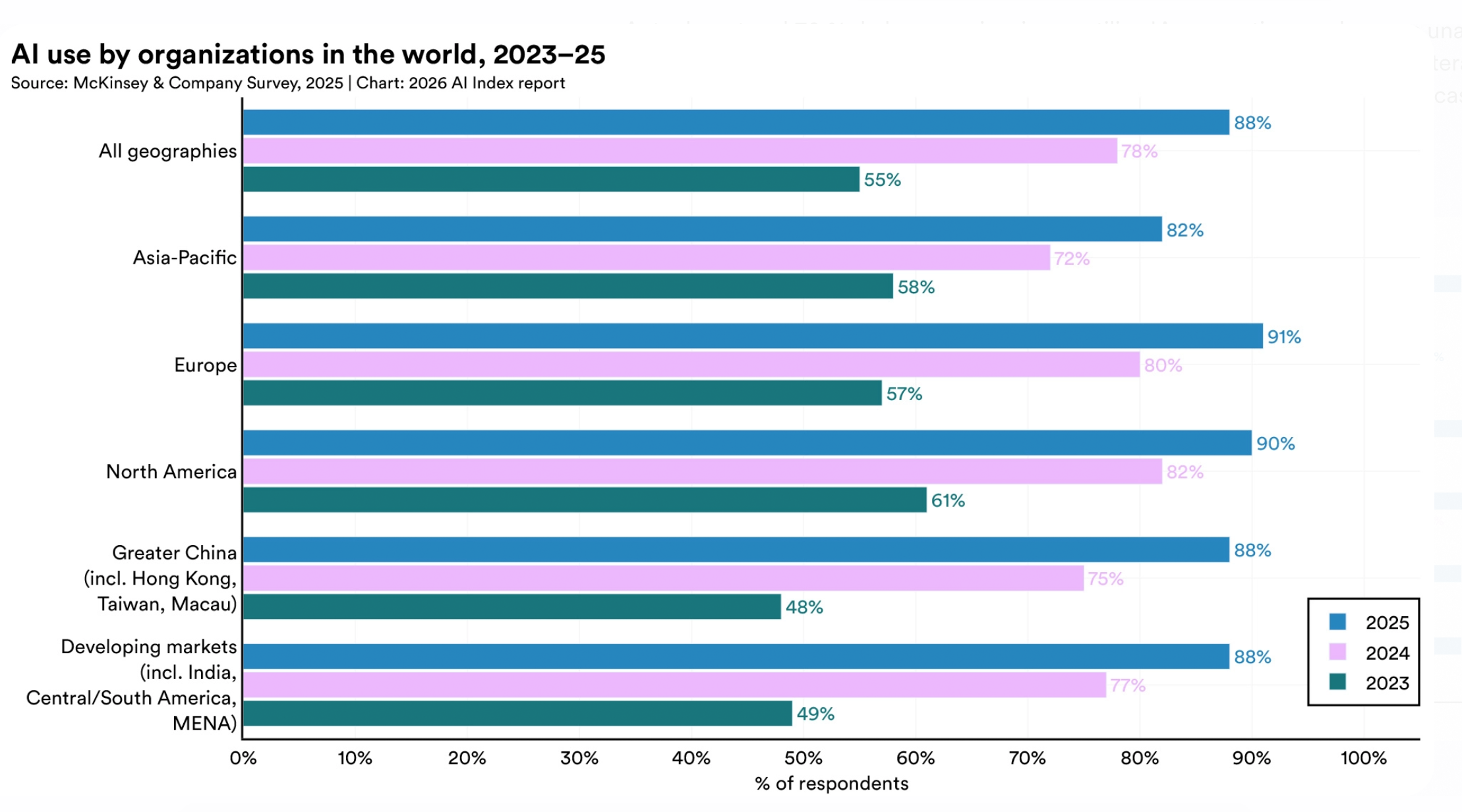
According to Stanford HAI Index 2026, 88% of the organisations surveyed reported using IA in at least one function during 2025, compared with 78% in 2025. In addition, more than half of the organizations reported using IA in three or more functions.
Generative IA also expanded its presence. 79% of the organizations surveyed reported using it regularly in at least one business function, compared with 71% of the previous year. China and Europe recorded some of the largest annual increases in adoption.
This evolution changes the business conversation. The central issue is the ability to integrate technology into specific processes, with defined economic and metric performance objectives.
For a CEO or commercial director, this involves reviewing where the IA can generate direct impact on income, costs, productivity and predictability.
Investment marks a new competitive scale
The volume of capital allocated to artificial intelligence confirms the economic dimension of this transformation.
Stanford estimates that global corporate investment in IA reached US$581.7 billion in 2025with a growth of 130% over the previous year. Private investment reached US$344.7 billion and grew 127.5%. The investment in generative IA increased by more than 200% and concentrated about half of private funding.
United States maintained a dominant position in private investment, with US$285.9 billion in 2025, compared to US$12.4 billion in China. Stanford warns that this comparison may underestimate the total volume of resources allocated by China due to the weight of public and state funds.
The investment dimension also appears in infrastructure. The major technology companies are strongly raising their capital costs to sustain computing capacity. Google, for example, reported more than US$150 billion capex per year in 2025.
For companies in other sectors, this investment scale has a specific consequence: the availability of IA tools will continue to expand and the relative cost of accessing advanced capacities will remain a strategic variable.
Productivity is beginning to be measured by function
One of the most relevant data in the report appears in the relationship between IA and productivity.
Stanford identifies increases from 14% and 15% in customer service, 26% in software development and 50% in marketing production. The greatest benefits appear in structured, measurable tasks with simple results to verify.
This point has a direct implications for management.
The productivity associated with IA can be more accurately analysed when the company breaks down its processes into specific activities. Attention to consultations, content generation, documentary analysis, programming, information classification and certain administrative tasks have favourable characteristics for this measurement.
The business decision requires identifying these functions before making extensive investments.
A company can have a high level of technological adoption and have a limited economic impact if the IA is incorporated without a precise definition of the process, indicator and expected result.
The commercial area enters a new stage of measurement
The productivity data in marketing is particularly relevant for B2B companies.
Content generation, commercial information analysis, account research, prospectus segmentation and certain commercial preparation tasks can incorporate IA tools within existing processes.
The strategic impact appears when these capabilities are connected to specific commercial variables: volume of opportunities, speed of response, cost of acquisition, account coverage, conversion and pipeline quality.
The IA can also expand the analytical capacity of commercial equipment working with large volumes of information.
The opportunity is linked to the structure of the business process. An organization with clear indicators can measure where technology generates productivity and where it requires process redesign.
Talent also begins to change
The adoption of IA has an effect on the composition of the teams.
The AI Index notes that labour impacts appear unevenly and more intensively in certain exposed groups and occupations. The use of software developers between 22 and 25 years of age fell by about 20% since 2024, while older workers experienced a different evolution. In addition, one third of the organizations surveyed expect to reduce their staff over the next year.
The data requires careful business reading.
The incorporation of IA modifies the combination of tasks, skills and professional profiles. For companies, this increases the importance of defining which functions require specialized knowledge, which activities can be automated and what new capacities must be developed internally.
Talent planning begins to be integrated with technology strategy.
Latin America faces an opportunity for selective adoption
The global expansion of the IA also opens an opportunity for Latin America.
Stanford shows that the adoption of generative IA reached 53% of the world's population in just three years. The rate of adoption has significant differences between countries and has a significant relationship with the level of income. At the same time, some markets reach higher levels than expected for their relative income.
The report also identifies Chile among the countries where IA's engineering capabilities are growing more rapidly.
For Latin American companies, this dynamic creates a scenario of increasing access to tools developed in leading markets.
The competitive advantage can arise from the ability to select applications with economic impact, integrate them into commercial and operational processes and build indicators to assess results.
The business priority goes by selecting where to capture value
Stanford's data show a simultaneous expansion of investment, adoption and productivity.
The strategic decision for companies is to translate this technological expansion into concrete priorities.
Three variables are of particular relevance:
1. Processes: identify activities where IA can generate measurable productivity.
2. Economy: to establish the impact on costs, income, margins and use of resources.
3. Structure: define responsibilities, internal capacities, indicators and investment criteria.
Technological adoption begins to form part of the business architecture. Value appears when the company can connect technology, processes and economic results within the same management logic.
The structure defines the ability to capture the value of the IA
The AI Index 2026 shows that artificial intelligence reached a significant business scale. 88% of the organizations surveyed already report some use of IA and global investment continues to grow at extraordinary rates.
For decision makers, the next challenge is linked to the ability to transform adoption into productivity, productivity into results and results into a sustainable business structure.
Artificial intelligence begins to function as a cross-sectional variable of competitiveness. Their impact will increasingly depend on the quality of the decisions accompanying their incorporation.
Vipzus accompanies in key production sectors in the diagnosis of opportunities, the management of their business structure and the definition of growth strategies. In a scenario where the IA modifies processes, capacities and investment criteria, strategic clarity takes on a central role in prioritizing opportunities and strengthening business predictability.
Sectoral radar