
Digital transformation label

The IA enters the business structure

What changes for companies according to Stanford?

The AI Index 2026 shows that artificial intelligence became a structural place in the organizations. Business adoption reached 88%, global corporate investment reached US$581.7 billion and the first productivity effects appear more clearly in functions where work can be measured. For companies, the strategic challenge is to order where to apply IA, how to measure its impact and what internal capacities to develop.

Business adoption reached a structural scale

Artificial intelligence entered a new stage of business adoption.

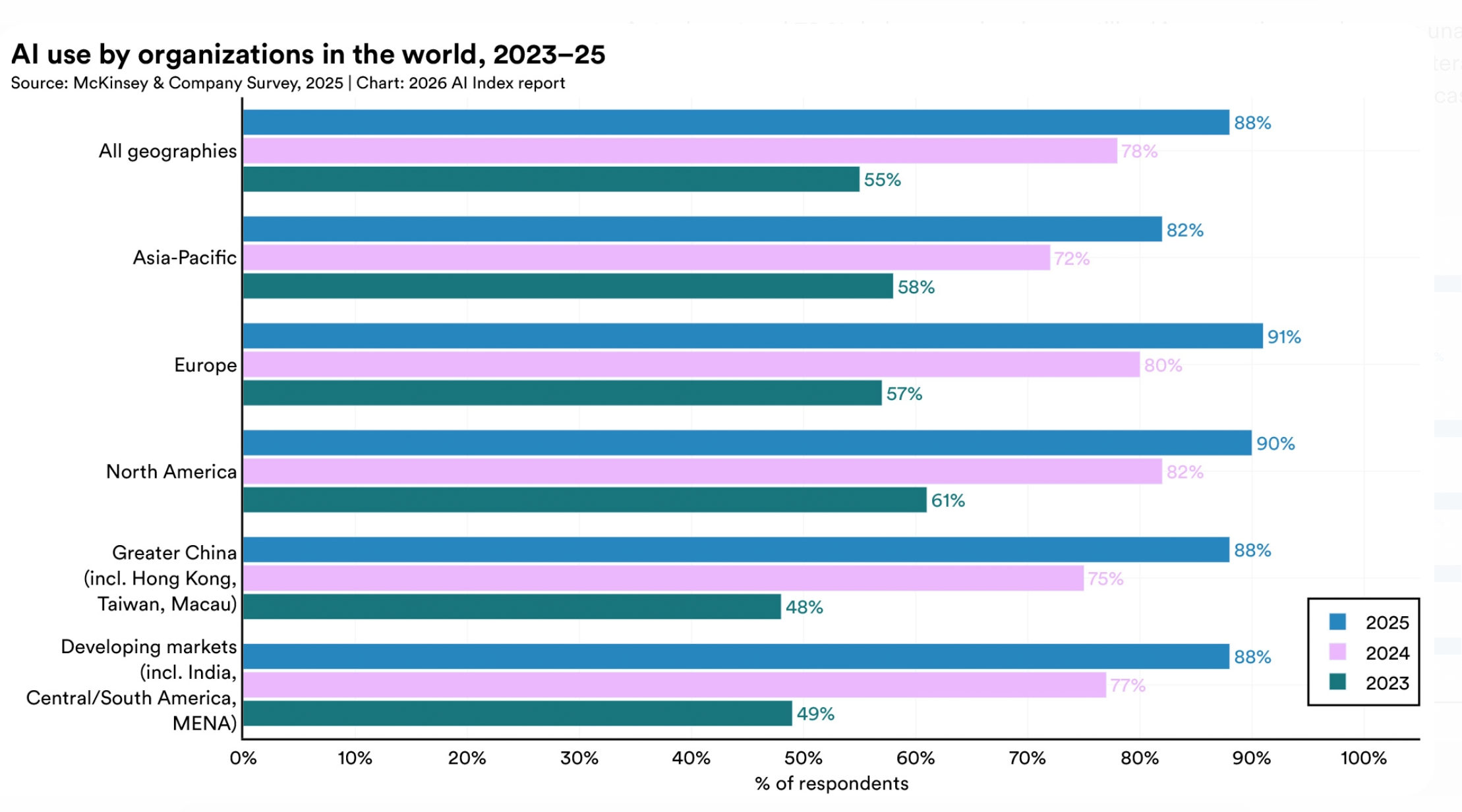
According to Stanford HAI Index 2026, 88% of the organisations surveyed reported using IA in at least one function during 2025, compared with 78% in 2025. In addition, more than half of the organizations reported using IA in three or more functions.

Generative IA also expanded its presence. 79% of the organizations surveyed reported using it regularly in at least one business function, compared with 71% of the previous year. China and Europe recorded some of the largest annual increases in adoption.

This evolution changes the business conversation. The central issue is the ability to integrate technology into specific processes, with defined economic and metric performance objectives.

For a CEO or commercial director, this involves reviewing where the IA can generate direct impact on income, costs, productivity and predictability.
Investment marks a new competitive scale

The volume of capital allocated to artificial intelligence confirms the economic dimension of this transformation.

Stanford estimates that global corporate investment in IA reached US$581.7 billion in 2025with a growth of 130% over the previous year. Private investment reached US$344.7 billion and grew 127.5%. The investment in generative IA increased by more than 200% and concentrated about half of private funding.

United States maintained a dominant position in private investment, with US$285.9 billion in 2025, compared to US$12.4 billion in China. Stanford warns that this comparison may underestimate the total volume of resources allocated by China due to the weight of public and state funds.

The investment dimension also appears in infrastructure. The major technology companies are strongly raising their capital costs to sustain computing capacity. Google, for example, reported more than US$150 billion capex per year in 2025.

For companies in other sectors, this investment scale has a specific consequence: the availability of IA tools will continue to expand and the relative cost of accessing advanced capacities will remain a strategic variable.

Productivity is beginning to be measured by function

One of the most relevant data in the report appears in the relationship between IA and productivity.

Stanford identifies increases from 14% and 15% in customer service, 26% in software development and 50% in marketing production. The greatest benefits appear in structured, measurable tasks with simple results to verify.

This point has a direct implications for management.

The productivity associated with IA can be more accurately analysed when the company breaks down its processes into specific activities. Attention to consultations, content generation, documentary analysis, programming, information classification and certain administrative tasks have favourable characteristics for this measurement.

The business decision requires identifying these functions before making extensive investments.

A company can have a high level of technological adoption and have a limited economic impact if the IA is incorporated without a precise definition of the process, indicator and expected result.

The commercial area enters a new stage of measurement

The productivity data in marketing is particularly relevant for B2B companies.

Content generation, commercial information analysis, account research, prospectus segmentation and certain commercial preparation tasks can incorporate IA tools within existing processes.

The strategic impact appears when these capabilities are connected to specific commercial variables: volume of opportunities, speed of response, cost of acquisition, account coverage, conversion and pipeline quality.

The IA can also expand the analytical capacity of commercial equipment working with large volumes of information.

The opportunity is linked to the structure of the business process. An organization with clear indicators can measure where technology generates productivity and where it requires process redesign.

Talent also begins to change

The adoption of IA has an effect on the composition of the teams.

The AI Index notes that labour impacts appear unevenly and more intensively in certain exposed groups and occupations. The use of software developers between 22 and 25 years of age fell by about 20% since 2024, while older workers experienced a different evolution. In addition, one third of the organizations surveyed expect to reduce their staff over the next year.

The data requires careful business reading.

The incorporation of IA modifies the combination of tasks, skills and professional profiles. For companies, this increases the importance of defining which functions require specialized knowledge, which activities can be automated and what new capacities must be developed internally.

Talent planning begins to be integrated with technology strategy.

Latin America faces an opportunity for selective adoption

The global expansion of the IA also opens an opportunity for Latin America.

Stanford shows that the adoption of generative IA reached 53% of the world's population in just three years. The rate of adoption has significant differences between countries and has a significant relationship with the level of income. At the same time, some markets reach higher levels than expected for their relative income.

The report also identifies Chile among the countries where IA's engineering capabilities are growing more rapidly.

For Latin American companies, this dynamic creates a scenario of increasing access to tools developed in leading markets.

The competitive advantage can arise from the ability to select applications with economic impact, integrate them into commercial and operational processes and build indicators to assess results.

The business priority goes by selecting where to capture value

Stanford's data show a simultaneous expansion of investment, adoption and productivity.

The strategic decision for companies is to translate this technological expansion into concrete priorities.

Three variables are of particular relevance:

1. Processes: identify activities where IA can generate measurable productivity.

2. Economy: to establish the impact on costs, income, margins and use of resources.

3. Structure: define responsibilities, internal capacities, indicators and investment criteria.

Technological adoption begins to form part of the business architecture. Value appears when the company can connect technology, processes and economic results within the same management logic.

The structure defines the ability to capture the value of the IA

The AI Index 2026 shows that artificial intelligence reached a significant business scale. 88% of the organizations surveyed already report some use of IA and global investment continues to grow at extraordinary rates.

For decision makers, the next challenge is linked to the ability to transform adoption into productivity, productivity into results and results into a sustainable business structure.

Artificial intelligence begins to function as a cross-sectional variable of competitiveness. Their impact will increasingly depend on the quality of the decisions accompanying their incorporation.

Vipzus accompanies in key production sectors in the diagnosis of opportunities, the management of their business structure and the definition of growth strategies. In a scenario where the IA modifies processes, capacities and investment criteria, strategic clarity takes on a central role in prioritizing opportunities and strengthening business predictability.

Slide

Evaluate a commercial diagnosis

Identify blocks and real opportunities for growth.


Customers, channels or markets

What risk does it pose for your company to depend on the same customers, channels or markets as usual?

The expansion of the technology sector maintains a sustained pace driven by artificial intelligence, automation and digitization of business processes.

In this scenario, many technology companies continue to grow on a commercial basis concentrated on a small set of customers, procurement channels or geographical markets. This concentration conditions business stability and limits the ability to sustain growth in the medium term.

Technology companies often develop long-term relationships with strategic customers. This model provides recurrent income and strengthens sectoral experience. At the same time, it increases exposure to any change in investment priorities, budgets or strategies of such clients.

Trade concentration increases business vulnerability

A concentrated portfolio amplifies the financial impact of each decision made by a relevant client. The cancellation of a contract, the reduction of the technological budget or a change of supplier may affect revenue, cash flow and investment capacity in innovation.

This scenario also conditions financial planning. Predictability depends on a limited number of external decisions, making it difficult to project growth more stable.

Traditional channels reach a point of maturity

Many technological companies built their growth through references, personal networks or historical alliances. These channels maintain strategic value, although they have limits to support expansion processes.

The B2B purchase process evolves towards digital routes where buyers investigate suppliers, compare solutions and use artificial intelligence tools to evaluate alternatives before first commercial contact. Visibility in different channels begins to directly influence the generation of opportunities.

Organizations that develop multi-channel strategies strengthen their ability to capture demand from different points of contact and reduce the dependence on a single business source.

Diversification strengthens trade predictability

Diversifying means expanding the commercial scope through new segments, industries, regions or marketing models. This strategy distributes risk and generates a more balanced income structure.

The incorporation of new markets also provides valuable information on emerging needs, strengthens innovation capacity and expands the competitive potential of the company.

Technology companies with structured business processes have better tools to identify opportunities, prioritize investments and manage sales cycles more accurately.

Expansion requires structure and priority criteria

Entering new markets requires informed decisions. The selection of segments, the value proposal, the commercial capacity and the resources available determine the feasibility of each initiative.

Sustained growth depends on a diagnosis to identify where there is the greatest potential for profitability, which channels have the best prospects and which customers contribute to building a more balanced portfolio.

The organizations that incorporate these criteria strengthen their resilience to economic, technological and competitive changes.

Strategic direction defines growth capacity

The development of the technological market increases the importance of regular review of the composition of the client portfolio, income distribution and the diversity of commercial channels. This assessment allows for the identification of concentration levels that could limit the future development of the company.

Slide

Evaluate a commercial diagnosis

Identify blocks and real opportunities for growth.


Mass hearing

The monetization of digital communities transforms the content industry

The global media and entertainment industry is undergoing a profound transformation in how to build value, attract attention and monetize content.

Mass audiences continue to take a scale, although economic growth in the sector is beginning to focus on community-based models, affinity and sustained engagement.

The change impacts directly on platforms, traditional media, producers, brands and companies linked to the advertising business.

The creative economy advances over segments historically dominated by large media groups. YouTube, Twitch, TikTok, Discord and live content formats consolidate an ecosystem where closeness with the audience generates more stable competitive advantages than traditional mass reach.

The phenomenon begins to modify monetization structures, advertising investment and digital positioning construction.

The fragmentation of consumption changes the rules of the audiovisual business

For decades, the media industry built scale from audience concentration. Open television, cable and large digital platforms organized business models supported in volume and mass distribution.

The expansion of social platforms altered that logic.

Current digital consumption is organized around specific interests, thematic communities and permanent relationships between creators and audiences. Sports, game, finance, lifestyle, technology and entertainment develop niche ecosystems with high levels of interaction.

The length of stay begins to have greater economic weight than the overall scope.

YouTube already represents one of the main global destinations of audiovisual consumption and strengthens leadership in the face of traditional streaming platforms. According to Nielsen, YouTube maintains one of the largest shares of television consumption connected in the United States during 2026, driven by creators and hybrid content between entertainment and community.

The economic impact is direct. The brands find more segmented, more precise metric audiences and potentially more efficient acquisition costs.

Monetization turns to models based on engagement and recurrence

Digital advertising goes through a transition oriented to quality of interaction and ability to influence.

Digital communities generate more frequent relationships, longer exposure time and higher levels of confidence compared to traditional advertising formats.

This scenario strengthens:

  • Subscriptions.
  • Membresies.
  • Exclusive content.
  • Live commerce.
  • Ssegmented Sponsorships.
  • Direct monetization of hearing.

The creator is no longer just a content producer. It begins to play a role similar to that of a specialized vertical environment with the capacity to mobilize specific communities.

Twitch, Patreon, YouTube Memberships and Discord accelerate models where the recurrence of income depends on loyalty and depth of the link with the audience.

The economic logic of the sector begins to move from the volume of impressions to community quality.

Media companies face pressure on their traditional structure

Traditional media groups are under increasing pressure on costs, monetization and retention of young audiences.

The growth of independent creators reduces entry barriers and multiplies content supply. Competition is no longer organized only between large companies.

The strategic challenge appears in the ability to build identity, differentiation and formats capable of sustaining attention in hyperfragmented ecosystems.

Audiences consume content on multiple platforms simultaneously:

  • Short clips.
  • Streaming live.
  • Podcasts.
  • Newsletters.
  • Video on demand.
  • Interactive content.

The distribution loses centrality as an exclusive competitive advantage.

The capacity to build community acquires greater economic and strategic value.

Various media groups begin to incorporate external creators, alliances with influences and collaborative formats to strengthen engagement and expand digital monetization.

The movement also impacts on commercial and advertising structures. The brands demand metrics linked to real interaction, loyalty and conversion.

Artificial intelligence amplifies competition for attention

Artificial intelligence accelerates large-scale content production, editing and adaptation. This expansion increases the volume of publications and deepens digital saturation.

In this context, the community is beginning to function as a competitive barrier.

The creators with fidealized audiences maintain the ability to sustain traffic, conversation and monetization even in environments with oversupply of automated content.

The perceived authenticity, constant interaction and sense of belonging strengthen the economic value of digital communities.

The impact also reaches companies outside the media sector.

Retail, technology, education, gaming and mass consumption begin to develop strategies focused on building their own community to reduce advertising dependence and strengthen direct relationships with customers.

Latin America accelerates the adoption of creative-based models

The region shows sustained growth in digital consumption, online video and creative economy.

Brazil, Mexico and Argentina concentrate an important part of the regional expansion of streaming, games and social platforms.

The phenomenon creates new opportunities for:

  • Producers.
  • Agencies.
  • Technology platforms.
  • Marks.
  • Digital media.
  • Advertising companies.

There are also challenges linked to monetization, regulation, intellectual property and dependence on global platforms.

Regional competitiveness is beginning to depend on the capacity to build communities with clear identity and sustainable monetization models.

Strategic value migrates to the direct relationship with the audience

The media and entertainment industry enters a stage where care is distributed among thousands of active and highly segmented communities.

The growth of the sector begins to depend less on a general scale and more on the depth of the link with the audience.

Community building emerges as one of the most relevant strategic variables for means, platforms and brands that seek income predictability and sustainable differentiation.

Slide

Evaluate a commercial diagnosis

Identify blocks and real opportunities for growth.


The visibility of the supply chain has an influence on logistical competition

The visibility In real-time supply chain is of strategic relevance in a market where information impacts on the profitability, confidence and continuity of contracts.

Logistics is undergoing a transformation driven by a growing demand for information. Industrial companies, retailers, e-commerce companies and organizations with complex operations incorporate new criteria for assessing their logistics suppliers. Among them, the ability to provide full visibility on the status of shipments, inventories and operational processes is increasingly relevant.

For years, operational efficiency concentrated much of the sector's attention. Traditional indicators linked to costs, delivery times and operational capacity remain critical. However, competitive dynamics incorporate a new variable: the quality of information available to the customer.

The visibility of the supply chain thus becomes a commercial asset with direct impact on loyalty and growth.

Information acquires economic value within the logistics proposal

Supply chains operate in environments characterized by greater volatility, stricter compliance requirements and increasing operational complexity.

In front of this scenario, customers seek to reduce uncertainty. The ability to know in real time the location of a load, anticipate deviations, monitor inventories or access to operational reports strengthens planning capacity and improves decision-making.

The information ceases to function only as an operational support and becomes part of the commercial value proposal.

Studies by international consultants such as McKinsey, Gartner and Deloitte show that organizations with higher visibility about their logistics operations are able to improve service indicators, optimize inventories and reduce costs associated with supply chain interruptions.

The business consequence is clear: customers assign economic value to the ability to access accurate and timely information.

Competitive pressure drives new service standards

The growth of e-commerce, the digitization of business processes and the expansion of monitoring platforms generate increasing expectations.

Corporate customers compare the logistical experience with the levels of visibility they find in other digital sectors. The permanent availability of information is gradually incorporated as a basic market expectation.

This changes the criteria for the evaluation of suppliers.

Timeliness remains important. The ability to report, anticipate and communicate acquires an equivalent relevance within the selection and stay processes of customers.

Logistic companies that offer monitoring platforms, custom dashboards, automatic alerts and integral traceability strengthen their positioning against competitors who compete mainly for price.

Tracability strengthens strategic accountability

Competition for tariffs creates constant pressure on the margins of the sector.

In this context, the construction of sustainable trade relations is increasingly dependent on the ability to generate perceived value.

Tracability contributes directly to this objective.

When a client can monitor critical operations, access historical information and have reliable indicators to manage his business, the business relationship becomes more strategic.

The conversation stops focusing exclusively on operational costs and begins to incorporate variables linked to planning, control and response capacity.

This change strengthens the permanence of strategic accounts and expands the possibilities of commercial expansion within existing customers.

Technological integration accelerates a new stage of differentiation

The expansion of Internet-related technologies of Things (IoT), intelligent sensors, artificial intelligence and data analysis platforms facilitates the construction of more transparent logistics models.

Technological investment is increasingly justified by commercial growth and customer retention.

Continuous data capture allows for the detection of incidents, the creation of early warnings and the construction of operational indicators with a level of detail higher than was available a few years ago.

Organizations that manage to integrate these capacities strengthen their capacity to respond to disruptive events and improve the experience of their clients.

The differentiation then arises from the ability to transform operational data into information relevant to decision-making.

The strategic challenge is to turn data into a competitive advantage

The availability of technology alone does not guarantee results.

Many organizations incorporate digital tools without a clear strategy to transform information into commercial value.

The competitive advantage appears when data can improve predictability, strengthen customer relationships and facilitate business decisions.

The challenge for logistics leaders is to identify which information generates value for each client segment and how to integrate it into a consistent service proposal.

Visibility becomes strategic when it helps to improve income, strengthen profitability and consolidate long-term relationships.

Visibility is incorporated into the core of logistics competitiveness

The evolution of supply chains shows a clear trend: operational transparency gains prominence in the factors that determine the competitiveness of the sector.

Logistic companies that develop traceability, monitoring and intelligent information management capabilities strengthen their position against increasingly demanding customers.

The next stage of growth of the sector will be associated with the ability to combine operational efficiency, data intelligence and customer experience within an integrated value proposal.

Slide

Evaluate a commercial diagnosis

Identify blocks and real opportunities for growth.


Media economy

Artificial intelligence changes the media economy and transforms the sector's sources of income

The expansion of artificial intelligence is generating one of the most profound changes in the global media and entertainment industry.

The technology began as a tool for automation and data analysis. It is now central to content production, audience management, digital advertising and monetization models.

The impact reaches traditional media, streaming platforms, entertainment companies, producers and independent creators. The ability to attract attention, turn audiences into income and build own digital assets takes on a new dimension in an ecosystem where artificial intelligence systems are increasingly involved in content distribution and discovery.

IA attendees join the content distribution chain

For more than two decades, search engines and social networks concentrated much of digital traffic. The emergence of conversational assistants based on artificial intelligence incorporates a new intermediary between content and audiences.

Millions of users start to consult tools such as ChatGPT, Perplexity, Gemini or Copilot for information, recommendations and specialized responses. This behavior changes the way people discover news, consume information and access entertainment content.

For the media, this dynamic introduces an additional strategic variable: visibility against artificial intelligence systems.

The quality of the sources, thematic authority, sectoral specialization and information clarity become more relevant within the mechanisms that use these systems to identify reliable content.

The monetization of hearings enters a new stage

Artificial intelligence also directly affects income.

Media companies use advanced analysis models to understand consumption habits, segment audiences and optimize subscription strategies.

The customization allows to offer more relevant content for each user, increasing indicators linked to permanence, recurrence and conversion.

International media groups also advance in predictive models capable of identifying cancellation behaviors, cross-selling opportunities and segments with greater monetization potential.

The economic consequence is significant: profitability is increasingly dependent on the ability to manage data, interpret behaviour and develop direct relations with audiences.

Content production incorporates new operational efficiencies

Artificial intelligence-based automation generates operational improvements in multiple areas.

Current tools allow:

  • Summarize complex information.
  • Generate versions adapted for different formats.
  • Optimize editing flows.
  • Accelerate documentation processes.
  • Automate repetitive tasks.

These capacities reduce production times and increase publication speed.

The strategic challenge is to preserve editorial differentiation, information quality and brand credibility in a context where content generation becomes more accessible to a growing number of actors.

The competitive advantage is increasingly concentrated on the ability to produce own analysis, expertise and value-added perspectives.

The care economy increases competition by relevance

Artificial intelligence amplifies the amount of content available and accelerates consumption cycles.

This dynamic increases competition for attention in an environment characterized by a virtually unlimited supply.

Media companies are facing increasing pressure to strengthen their thematic positioning and build communities with defined interests.

Organizations that develop authority in specific niches are more likely to generate brand recognition, improve their conversion metrics and increase the commercial value of their audiences.

Specialisation emerges as a strategic variable to sustain growth and profitability.

The economic value of trust takes on a higher dimension

The proliferation of content generated by artificial intelligence increases the importance of trust as a business asset.

The source of information, the quality of the sources and the reputation of the brands have an increasing impact on consumer decisions.

This phenomenon strengthens the position of media, platforms and producers capable of demonstrating editorial rigour and consistency in their content.

Confidence begins to function as an economic differential capable of impact on subscriptions, advertising agreements and long-term business opportunities.

Latin America faces a strategic positioning opportunity

The growth of conversational attendees provides an opportunity for specialized organizations to gain visibility through high-quality content, sectoral approach and capacity to respond to specific market problems.

The media economy is moving towards a scenario where distribution, monetization and confidence-building will increasingly be linked to the interaction between human audiences and artificial intelligence systems.

The strategic decisions made during this stage will have an impact on the growth, profitability and positioning capacity of industry companies over the next decade.

Slide

Evaluate a commercial diagnosis

Identify blocks and real opportunities for growth.


Community influence

World of creators: how influential communities are transforming the global care business

The Tim Payne case presents a new dynamic in the media and entertainment industry: digital communities have the capacity to create relevance, alter audience metrics and generate commercial value on a global scale.

The World Cup always worked as one of the world's largest care distribution platforms. The 2026 edition incorporates an additional variable: the power of digital communities organized around influencers. The phenomenon already affects audiences, sponsorship, monetization and positioning of sports brands.

The case of New Zealand football player Tim Payne became one of the most illustrative examples of this transformation. Before the tournament, the defender had less than 5,000 followers in Instagram. After a campaign led by Argentine creator Valen Scarsini, known as «The Scarso», Payne accumulated millions of followers in a few days and became one of the World Cup's viral stories. Several international media reported the exponential leap of their digital audience and the commercial interest generated around their figure.

Global care is organized around communities

Social platforms consolidated a new media distribution model. The algorithms amplify content with high participation and communities function as range accelerators.

The Tim Payne phenomenon shows a relevant dynamic: a coordinated digital community can install a global narrative without relying on traditional media structures. The player went from being a low-visibility participant to becoming one of the most commented names of the tournament thanks to the collective mobilization of followers.

For the media and entertainment industry, this evolution changes the logic of audience generation. The strategic asset already includes the ability to activate communities with a high level of participation.

The fandom economy takes up a commercial scale

Digital communities generate specific economic externalities. A massive increase of followers impacts on visibility, trade agreements, sponsorship opportunities and personal brand value.

Recent reports point out that the growth in Payne's popularity aroused sports and commercial interest in clubs in different markets. Digital visibility begins to influence decisions linked to the sports business.

This scenario expands monetization sources for leagues, clubs, platforms and creators. The hearings are actively involved in the construction of value and change the traditional cycle of content production and consumption.

Influencers compete for the construction of the tournament account

Research on high-intensity sports events shows that journalists, media and influences participate in a hybrid ecosystem of public conversation generation. The information authority is living with new actors capable of mobilizing mass audiences.

During the World Cup, digital creators have relevant advantages:

  • Publication speed.
  • Emotional cercania with the audiences.
  • Native formats for TikTok, Instagram and YouTube.
  • High capacity for viralization.

The result is a structural change in the sports market. The control of care is distributed among multiple actors with different capacities.

Regulation begins to accompany the growth of the creating ecosystem

The economic growth of the sector also drives new regulatory frameworks. The United States confirmed specific migration requirements for international influences that produce monetized content during the 2026 World Cup. The authorities consider certain digital activities to be regulated work.

This decision reflects the growing institutionalization of the creative economy. The digital content associated with major sports events is consolidated as an industry with direct economic impact.

For media companies, agencies, platforms and global brands, regulatory compliance is of strategic importance in the planning of international campaigns.

Community-based monetization strategies gain prominence

The Tim Payne case provides a business lesson with broad implications: active communities can create large-scale relevance with reduced marginal costs. The competitive differential arises from the ability to generate belonging, identity and collective participation.

Sector organizations face new strategic questions:

  • Which communities have a real capacity for mobilization?
  • How is the economic value of engagement measured?
  • What monetization models offer greater predictability?
  • How to integrate creators into long-term media strategies?

The answer to these questions will influence advertising revenue, audience acquisition and brand construction over the next decade.

The 2026 World Cup confirms that the global entertainment business is moving towards community-driven ecosystems. The attention becomes a distributed asset and the activation capacity acquires an increasing strategic value.

Slide

Evaluate a commercial diagnosis

Identify blocks and real opportunities for growth.


Software consolidation

Strengthening the business software market: why medium-sized enterprises become strategic assets

The global business software market is undergoing an accelerated consolidation stage.

Investment funds, large technological groups and specialized companies intensify acquisitions aimed at capturing portfolio, intellectual property, sectoral positioning and commercial capacity.

The dynamics especially affect medium-sized B2B, SaaS and technology services with a consolidated technical trajectory and still immature business structures.

The phenomenon responds to a profound change in the priorities of the sector. The market began to value predictability, profitability and specialization more intensively than disorderly growth driven exclusively by user expansion or capital investment.

Profitability and recurrence gain strategic weight

For more than a decade, much of the technological ecosystem operated under models oriented to accelerated growth, geographical expansion and rapid market capture.

The global financial scenario introduced new priorities.

The increased cost of capital, margin pressure and increased investment selectivity strengthened criteria related to:

  • Recurrence of income.
  • Contractual stability.
  • Pipeline quality.
  • Commercial efficiency.
  • Customer concentration.
  • Cost-effective expansion capacity.

Companies with recurrent income, clear sectoral niches and efficient operating structures began to attract greater interest from strategic buyers and investors.

Business software is consolidated as critical infrastructure for multiple industries. This condition strengthens procurement processes aimed at integrating solutions, expanding ecosystems and ensuring competitive positioning.

Medium-sized enterprises concentrate procurement opportunities

The consolidation finds a particularly fertile ground in specialized medium-sized companies.

Many companies developed solid products, experienced technical equipment and in-depth knowledge of certain sectors. At the same time, they have limitations linked to trade scale, international positioning or regional expansion capacity.

This profile creates strategic opportunities for actors with greater financial capacity and consolidated trade structure.

Acquisitions make it possible to accelerate:

  • Portfolio expansion.
  • Access to specific segments.
  • Technological integration.
  • Sectoral specialization.
  • Regional coverage.
  • Advisory capacity.

In sectors such as logistics, health, retail, energy and agro-industry, vertical solutions become increasingly relevant within corporate strategies.

Specialisation begins to function as a value multiplier.

Consolidation changes technological competence

Market concentration causes structural changes over competitive dynamics.

The larger companies strengthen investment capacity, expand product ecosystems and improve service integration. Medium-sized enterprises face an environment of greater trade pressure and a need for strategic differentiation.

The competition is gradually moving from isolated functionalities to integral models of solution.

Corporate customers prioritize suppliers capable of offering:

  • Operational continuity.
  • Technological integration.
  • Financial stability.
  • Scalable support.
  • Sectoral vision.
  • Long-term accompanying capacity.

Technical positioning remains relevant, although commercial and strategic capacity gains influence on purchase decisions.

The value of the software moves towards sectoral knowledge

One of the most relevant changes on the market appears in the recovery of industry-specific knowledge.

Technology companies with operational understanding of certain sectors develop competitive advantages that are more difficult to replicate.

Solutions designed for logistics, manufacturing, health or agro-industry incorporate particular processes, indicators and needs that strengthen entry barriers.

The market awards companies capable of combining:

  • Technological development.
  • Customer's economic reading.
  • Operational understanding.
  • Advisory capacity.
  • Regulatory knowledge.
  • Sectoral adaptation.

Verticalization improves trade efficiency and strengthens the construction of authority within the market.

Latin America accelerates concentration processes

The region is undergoing a relevant transformation stage within the technological ecosystem.

The growth of business digitization, automation and applied artificial intelligence expands opportunities for expansion. At the same time, competition increases by scale, positioning and financing capacity.

Regional and international funds observe opportunities for companies with:

  • Consolidated corporate portfolio.
  • Recurrent income.
  • Sectoral specialization.
  • Low international penetration.
  • Trade structure in development.

In many cases, the main limitation to scaling appears in the commercial and strategic organization rather than in technical capacity.

Market consolidation also promotes alliances, mergers and integration agreements between medium-sized companies seeking to gain volume and competitive capacity.

The commercial structure becomes a valuation factor

The current dynamics change the way in which the value of a technology company is evaluated.

Pipeline quality, trade predictability and income stability take strategic weight within investment and procurement processes.

Companies capable of demonstrating:

  • A consistent generation of opportunities.
  • Clear commercial segmentation.
  • Low dependency on individual customers.
  • Positioning defined.
  • Contractual recurrence.
  • Cost-effective expansion.

They strengthen their capacity for negotiation and growth.

The technological market enters a stage where the business structure begins to have a direct impact on business valuation.

The ability to order expansion, build predictability and develop sectoral positioning becomes relevant within global technological competitiveness.

Slide

Evaluate a commercial diagnosis

Identify blocks and real opportunities for growth.


IA and energy

Artificial intelligence drives a new global career for energy

The growth of artificial intelligence is generating a profound transformation in energy markets.

The expansion of data centres, digital infrastructure and intensive processing systems is increasing global electricity demand and accelerating investment in generation, networks and storage.

Data centres become large new energy users

Generative artificial intelligence entered an accelerated adoption stage. Technology companies, governments and multi-industry organizations are incorporating IA models to automate processes, develop products and increase productivity.

Behind that transformation is a variable that begins to gain prominence in the global energy agenda: electricity consumption.

Advanced models of artificial intelligence require enormous processing capabilities. Each new generation of data centres requires more computer power, more cooling and permanent availability of energy.

According to projections of the International Energy Agency (IEA), data centres will be one of the main drivers of growth in electricity demand over the next decade.

Energy is consolidated as a strategic factor to sustain digital expansion.

Energy infrastructure enters a new stage of investment

The global energy discussion incorporates a new priority: to ensure sufficient capacity to supply the growing demand associated with the digital economy.

Lead technology companies are signing long-term energy supply agreements to ensure operational stability and cost predictability.

At the same time, electricity companies, network operators and investment funds are accelerating projects related to:

  • Renewable generation.
  • Energy storage.
  • Extension of transmission networks.
  • Modernization of distribution systems.
  • Support infrastructure for data centres.

Energy availability is beginning to influence decisions to locate new technological investments.

Regions with access to competitive energy, network capacity and regulatory stability acquire a growing advantage in attracting projects linked to artificial intelligence.

The electrical network emerges as a strategic asset

The growth of electricity demand is shifting part of the focus from generation to networks.

In many developed markets, the times needed to connect new energy or technological projects create challenges for capacity expansion.

Investment in transmission and distribution becomes relevant within national energy plans.

This phenomenon is promoting opportunities to:

  • Electrical equipment manufacturers.
  • Infrastructure developers.
  • Network operators.
  • Companies specialized in energy digitization.
  • Suppliers of storage solutions.

The quality and availability of electricity infrastructure become factors that have a direct impact on economic competitiveness.

Energy and technology consolidate a new strategic relationship

Historically, the energy and technological sectors evolved with relatively independent dynamics.

The expansion of artificial intelligence is generating an ever-deeper convergence between the two ecosystems.

Large technologies are actively involved in energy projects, finance renewable developments and explore direct agreements with generators to ensure long-term supply.

Energy begins to be part of the corporate strategy of companies whose main business is linked to software, data and digital innovation.

This integration is changing the competitive dynamics of both sectors.

Latin America finds an opportunity for positioning

The region has relevant attributes to participate in this new phase of the global energy market.

The abundance of renewable resources, the availability of facilities for infrastructure expansion and the growth of investment in generation offer favourable conditions for attracting projects linked to digital economy and artificial intelligence.

Countries with stable regulatory frameworks, access to long-term financing and energy planning can capture a significant part of the investments that will seek new locations for data centres and technology operations.

The capacity to articulate energy policies, infrastructure and productive development will have a direct impact on regional competitiveness over the coming years.

Energy takes on a central role in the economy of artificial intelligence

The expansion of artificial intelligence is incorporating a new variable into the global business agenda: energy availability.

The capacity to generate, transport and manage electricity will be crucial to sustain the growth of digital infrastructure.

Energy companies, technological developers, investors and governments are entering a stage where energy, data and computer capacity are part of the same strategic equation.

The evolution of this trend will have a direct impact on investment, competitiveness and economic development in multiple industries.

Slide

Evaluate a commercial diagnosis

Identify blocks and real opportunities for growth.


Real Estate Tokenization

The digitization of the real estate accelerates the adoption of IA, tokenization and data-based management

The technological transformation of the real estate is going through a new stage of maturity.

The sector is beginning to incorporate artificial intelligence, automation and predictive analysis as central tools for improving operational efficiency, marketing and decision-making.

The growth of the PropTech ecosystem in Latin America drives investments in smart management platforms, digital investment models and market analysis tools. Technological developments change the competitive logic of the sector and increase the importance of analytical capacity over real estate assets.

Recent reports from international consultants and industry-related organizations show an acceleration in the adoption of data-based solutions, especially in corporate, logistical, multi-family and commercial segments.

Artificial intelligence gains space in valuation, pricing and demand analysis

Artificial intelligence begins to play an increasingly relevant role in the operational structure of the real estate. Industry companies use predictive models to analyse demand behaviour, absorption speed, price evolution and vacuum risks.

The availability of market data, combined with machine learning tools, makes it possible to build more accurate business projections and improve the segmentation of buyers and investors.

The use of IA also impacts on:

  • Automation of commercial processes.
  • Generation of qualified leaders.
  • Optimization of campaigns.
  • User behavior analysis.
  • Asset management.

The commercial response speed begins to become a central competitive variable for developers, brokers and real estate operators.

The market also incorporates dynamic pricing solutions to adjust income and marketing values according to demand, location, timing and rotation.

This logic already has a strong presence in hospital and multifamily in the United States and Europe, and it begins to expand to Latin American markets with more operational professionalism.

Tokenization drives new real estate investment models

The tokenization of real estate assets gains visibility as a mechanism to expand access to investment and generate greater liquidity on traditionally illiquid assets.

The advance of lockchain and fractional investment platforms enables new schemes of participation on commercial properties, residential income and specific developments.

Interest in these models is particularly growing in:

  • Young investors.
  • Digital profiles.
  • Markets with access to credit restrictions.
  • Regional structures for diversified investment.

Tokenization also begins to be observed by funds and institutional investors as a tool for expanding capital base and improving placement speed.

Regulatory development still has significant differences between countries. However, the financial and technological ecosystem maintains a sustained expansion trend.

The evolution of the model will depend on:

  • Legal security.
  • Financial regulation.
  • Asset traceability.
  • Operational transparency.
  • Institutional trust.

The data becomes a strategic asset of the real estate business

The digitization of the sector increases the strategic value of operational and commercial data.

Real estate companies start using integrated dashboards to monitor:

  • Behavior of demand.
  • Commercial conversion.
  • Procurement costs.
  • Occupation levels.
  • Profitability by segment.
  • Asset performance.

The ability to interpret information in real time begins to influence expansion, pricing, investment and portfolio development decisions.

This development also affects the relationship between commercial, marketing and operation. The integration of areas gains relevance in structures that seek predictability and sustained growth.

The market is beginning to differentiate between operators with consolidated analytical capacity and structures with low technological integration.

Smart assets raise competitive pressure on developers and operators

The incorporation of technology into real estate assets also advances rapidly.

Corporate buildings, industrial parks and premium developments include:

  • IoT sensors.
  • Intelligent energy consumption systems.
  • Operational monitoring.
  • Maintenance automation.
  • Experience platforms for users and tenants.

Energy efficiency and smart management capacity begin to influence recovery, operational costs and attractiveness for institutional investors.

The ESG criteria also gain weight in asset financing and assessment decisions, especially in international markets.

The ability to build technologically prepared assets becomes a positioning factor for developers and funds.

Latin America accelerates its PropTech ecosystem

The Latin American PropTech ecosystem maintains a process of expansion driven by technological investment, urban growth and operational professionalism.

Brazil and Mexico concentrate much of the regional activity, although there are also relevant developments in Argentina, Colombia and Chile.

The region presents opportunities related to:

  • Digitization of fragmented processes.
  • Low historical technological penetration.
  • Growth of the multifamily segment.
  • Logistics expansion.
  • The need for greater trade efficiency.

Technological progress also changes the competitive dynamics between traditional actors and new digital operators.

Companies with the greatest technological adaptation capacity begin to capture advantages in:

  • Trade speed.
  • Quality of experience.
  • Operational efficiency.
  • Access to capital.
  • Demand construction.

The trade structure is beginning to depend on analytical capacity and predictability

The digital transformation of the real estate changes the business management logic of the sector.

Growth is increasingly dependent on:

  • Data quality.
  • Commercial traceability.
  • Process automation.
  • portfolio segmentation.
  • Technological integration.
  • Predictive capacity.

Operational professionalism is of relevance to more competitive markets and more demanding financial cycles.

The ability to build commercial predictability becomes a strategic differential for developers, operators and real estate funds.

Slide

Evaluate a commercial diagnosis

Identify blocks and real opportunities for growth.


Cybersecurity and technology

Cybersecurity becomes a structural axis of digital business

The expansion of artificial intelligence, automation and connected platforms is changing the risk structure of technology companies and all digital production sectors.

Cybersecurity began to be central to strategic decisions linked to operational continuity, corporate reputation and financial predictability.

The global market is going through a stage where digitization advances on critical operations, industrial infrastructure, commercial management and supply chains. This process extends the area of exposure to computer attacks, data theft, operational interruptions and systemic vulnerabilities.

The evolution of the digital business is driving a change of criterion in directories and executive teams: computer security went from a technical function to a structural variable of the business.

Automation Expands Business Operational Risk

The accelerated incorporation of artificial intelligence and automation generated a massive expansion of connected devices, platforms and processes. This dynamic increases access points and operational complexity.

Attacks on logistics chains, financial platforms, industrial systems and SaaS companies began to show a growing economic impact on income, reputation and operational continuity.

According to recent reports from Deloitte and international agencies specialized in cybersecurity, threats related to generative IA, Ransomware and automated attacks are increasing speed and sophistication in global markets.

The situation is becoming more sensitive in Latin America, where many companies maintain fragmented technological structures, low level of integration and reactive security policies.

The exposure increases especially in companies that grew rapidly during digitization and commercial expansion processes without consolidating a robust protection and monitoring architecture.

The economic cost of a digital interruption gains scale

The growing dependence on digital platforms is raising the financial impact of any operational interruption.

A fall in infrastructure, an attack on sensitive data or a vulnerability in critical systems can simultaneously affect:

  • Facturing.
  • Logistics.
  • Customer service.
  • Corporate reputation.
  • Regulatory compliance.
  • Relationship with investors and partners.

The problem ceased to focus only on technical recovery. The current impact involves a deterioration of confidence, loss of contracts and increased operating cost.

The sectors with distributed operations and high digitization show greater sensitivity:

  • Logistics.
  • Energy.
  • Retail.
  • Financial services.
  • Cheers.
  • Industrial manufacturing.
  • Technology platforms B2B.

In these markets, operational continuity became part of the competitive positioning.

Artificial intelligence accelerates threat sophistication

The evolution of generative artificial intelligence is also changing the global cybersecurity scenario.

The new models make it possible to automate attacks, develop more precise phishing campaigns and increase the capacity to escape traditional protection systems.

In parallel, companies are using IA for predictive monitoring, early threat detection and automated vulnerability analysis.

The technological market is beginning to consolidate a new competitive career linked to self-security and real-time response capacity.

Large global technology companies are increasing investment in security infrastructure, cloud protection platforms and IA-driven defence systems. The strategic priority is focused on operational resilience and protection of critical digital assets.

Regulation begins to raise business standards

Regulatory pressure also began to intensify.

The United States, Europe and different Asian markets are making progress in regulatory frameworks linked to data protection, critical infrastructure and corporate responsibility for digital incidents.

Regulatory requirements begin to impact on:

  • Corporate reporting.
  • Technology audits.
  • Data management.
  • Operational traceability.
  • Relationship with technology providers.

This dynamic creates additional pressure on medium-sized enterprises and organizations with decentralized technological processes.

Cybersecurity is beginning to be integrated into decisions related to compliance, financing, corporate insurance and investment risk assessment.

Digital predictability becomes a competitive advantage

Technology companies and digitalization-intensive sectors face a new competitive demand: to sustain resilient and predictable operations in high digital exposure environments.

The ability to anticipate risks, monitor vulnerabilities and respond quickly to incidents begins to influence:

  • Profitability.
  • Trade stability.
  • Reputation.
  • Expansion capacity.
  • Market value.

The market begins to award organizations with integrated technological structures, clear protocols and strategic digital risk management capacity.

The evolution of the sector shows a growing convergence between technology, operational continuity and corporate strategy.

Cybersecurity is now directly associated with business sustainability and long-term competitiveness.

Slide

Evaluate a commercial diagnosis

Identify blocks and real opportunities for growth.